
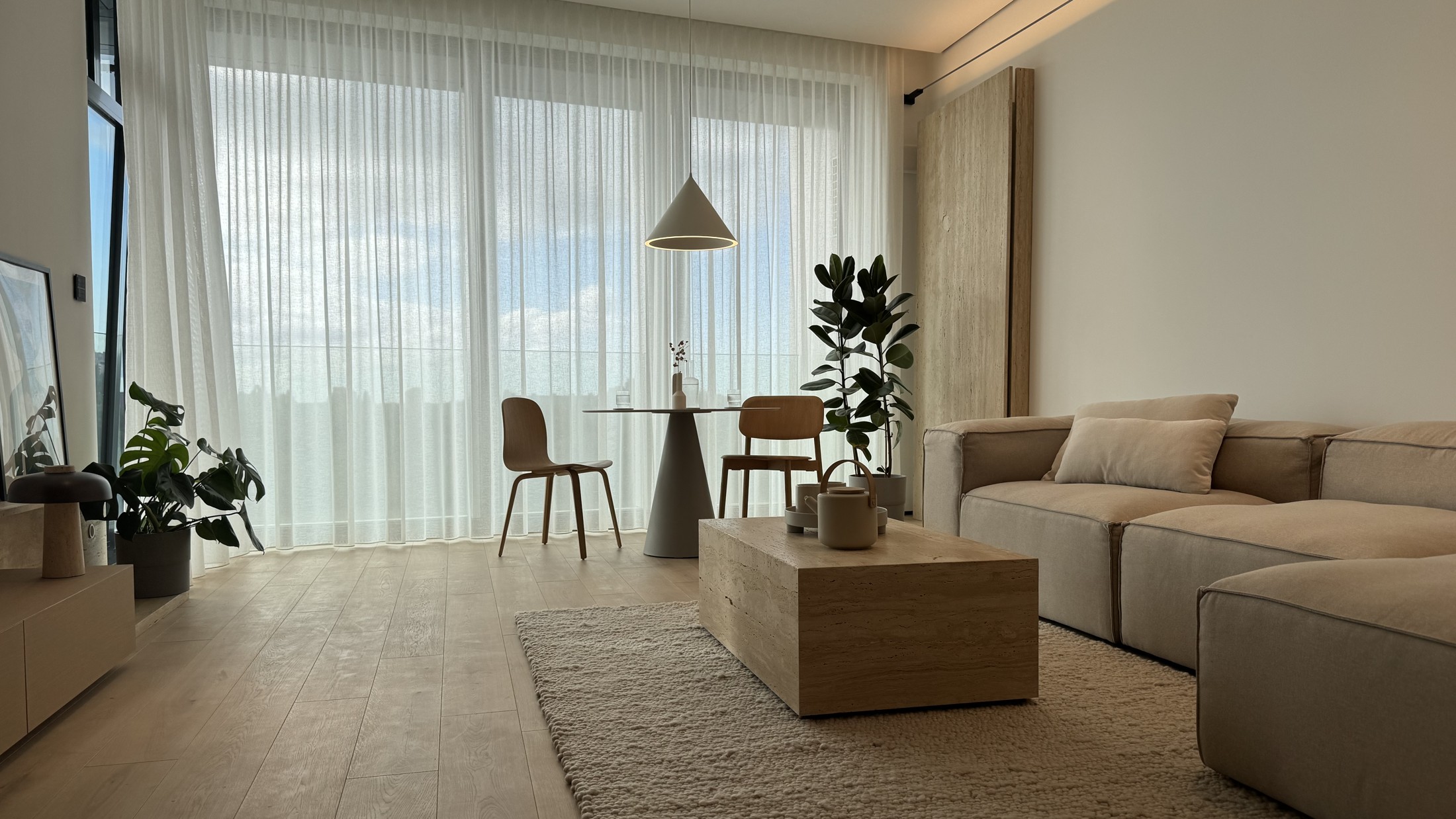
We consider flooring in almost every project. Clients usually know the look they like, but the range of materials and conflicting recommendations can make the decision difficult.
In residential interiors, we often specify wooden flooring. We most often bond it across the full surface because this installation method creates a firm feel underfoot, a calmer sound and clean transitions between rooms.
A material that feels pleasant to the touch
The reason wood feels warmer underfoot is physical. It has lower thermal conductivity than ceramic or stone, so it draws heat from the foot more slowly. Two surfaces may have the same temperature, yet feel different to the touch.
The difference is most noticeable in bedrooms, living rooms and children’s rooms—anywhere people walk barefoot or children play directly on the floor.
Wood can also be combined with underfloor heating when the selected flooring is suitable and the entire build-up is correctly designed. We assess its thickness, thermal resistance, wood species and installation method. Manufacturers usually specify a maximum surface temperature of 27 °C and require even heat distribution.

A difference drawings cannot show
You can hear the difference between a floating and bonded floor from the first few steps. The resilient layer beneath a floating floor can create a more hollow, sometimes slightly booming sound. A bonded floor is connected to the substrate across its full area, so it feels firmer and more compact.
Sound within a room is not the same as impact noise transmitted to neighbours. That depends on the entire floor structure: screed, resilient layers, perimeter joints and penetration details. In acoustically sensitive projects, we therefore assess the whole construction—not only the flooring.
The difference between floating and bonded flooring is best heard and felt while walking.
Wood remains wood—but its movement can be controlled
Wood responds to its environment. It contracts when the air is dry and expands when humidity rises. This is a natural property of the material and no installation method can eliminate it.
A flexible adhesive holds each board across its full area and transfers movement more evenly into the substrate. The floor flexes less and avoids hollow spots underfoot. Correct expansion joints and a stable indoor climate are still essential. As a guideline, we use a temperature of around 20 °C and relative humidity of 35–65%, while the selected manufacturer’s instructions remain decisive.

Seamless transitions without distracting strips
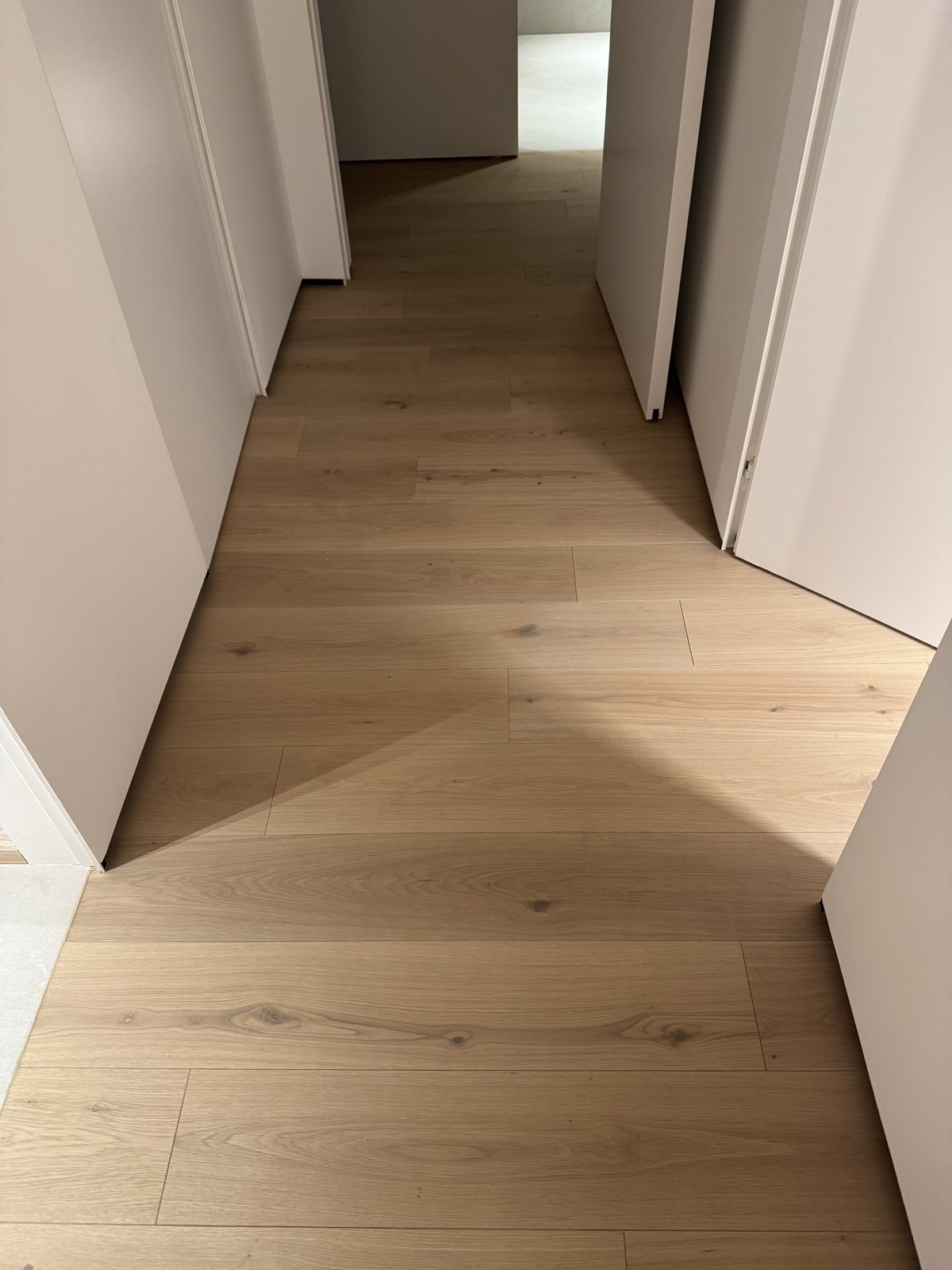
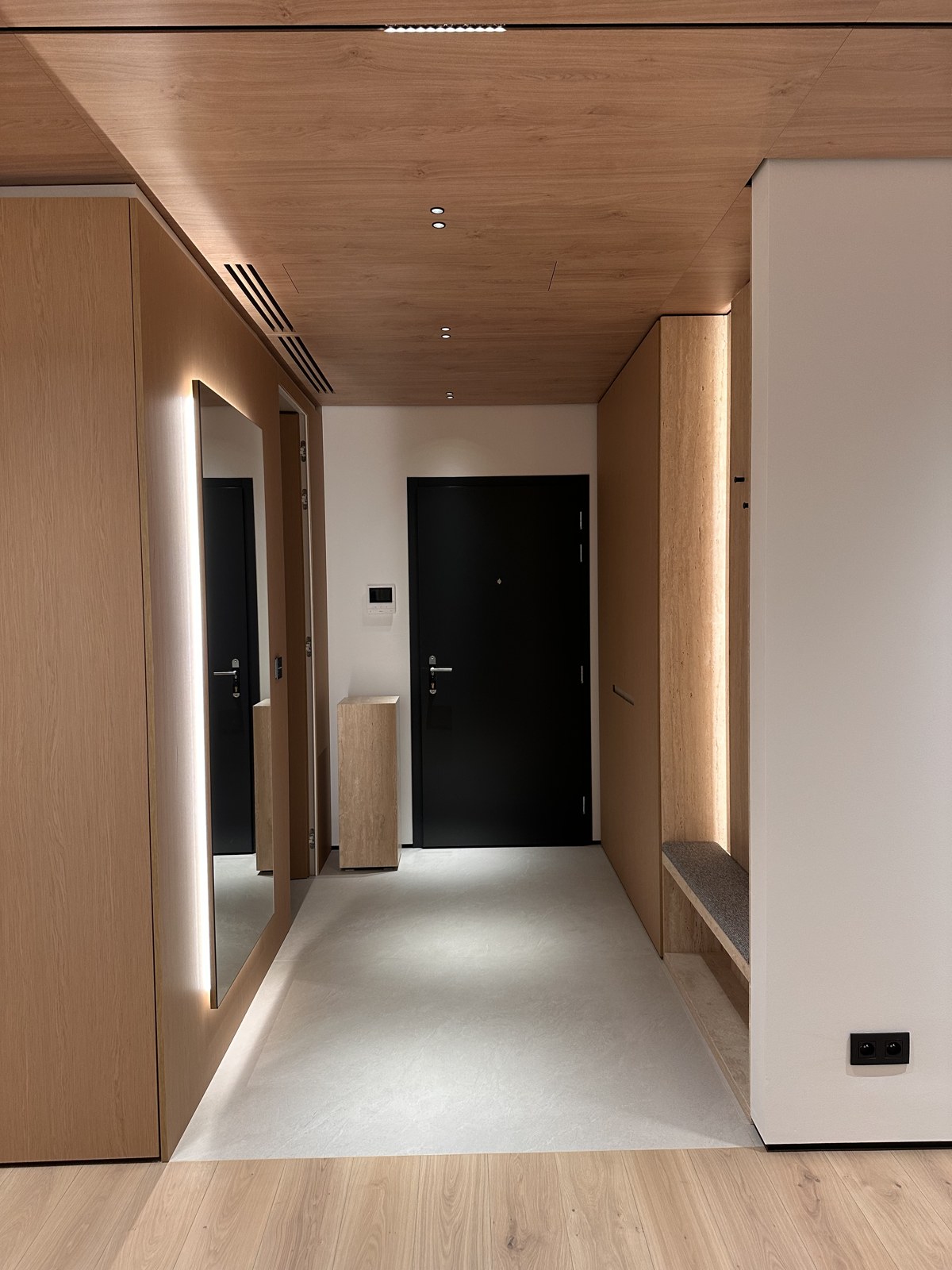
For us, this is one of the strongest reasons for full-surface bonding. When the floor build-up and geometry allow it, the same flooring can continue from the living room through the hallway into a bedroom or study without raised transition strips in doorways.
The interior no longer feels like a series of separate rooms. The floor visually connects them into one whole. This detail is especially important with flush doors, concealed frames and open layouts. You can see similar solutions in our interior projects.
We assess the possibility of crossing doorways without a visible joint separately for every project. The flooring type, laying direction, shape and size of the area, underfloor heating and location of substrate joints all matter. Large or complex areas may still require additional divisions.
Why we prefer it
A bonded wooden floor behaves as part of the substrate when walked on. It feels firm and sounds consistent across the entire area.
Heat transfer is another advantage with underfloor heating. There is no continuous air or foam layer between the flooring and screed, so the build-up can have lower thermal resistance than a comparable floating floor with underlay. The manufacturer must nevertheless confirm compatibility between the flooring, adhesive and heating system.
Another benefit is local repair. A damaged board can be professionally cut out, the adhesive residue removed and a new board installed without dismantling the floor from the nearest wall. We therefore recommend keeping several boards from the same production batch.

Lower risk of spreading—not a waterproof floor
When correctly applied, adhesive fills the space between the flooring and substrate. This avoids the continuous voids typical of spot or strip bonding through which water could spread beneath the floor.
Full-surface bonding does not make a wooden floor waterproof. Water can penetrate joints, edges and penetrations. Prolonged moisture can cause swelling or deformation even in bonded flooring, so spills must be removed immediately. For regularly wet areas, we select a more suitable material or a specially designed build-up.
It is not a universal answer
We do not choose full-surface bonding automatically. A floating floor may be more practical in a rental or temporary interior, during a fast renovation or where easy removal matters. If the substrate cannot be prepared to the required standard, a different build-up is necessary.
We particularly consider full-surface bonding:
- With underfloor heating and a need for efficient heat transfer
- For continuous areas and strip-free transitions between rooms
- When a firm, refined feel underfoot is required
- For patterned layouts such as herringbone
- Where the floor should remain locally repairable over the long term
We do not decide based on room size alone. The flooring parameters, spatial layout, substrate condition, heating and project-specific requirements are decisive.
The result is only as good as the substrate
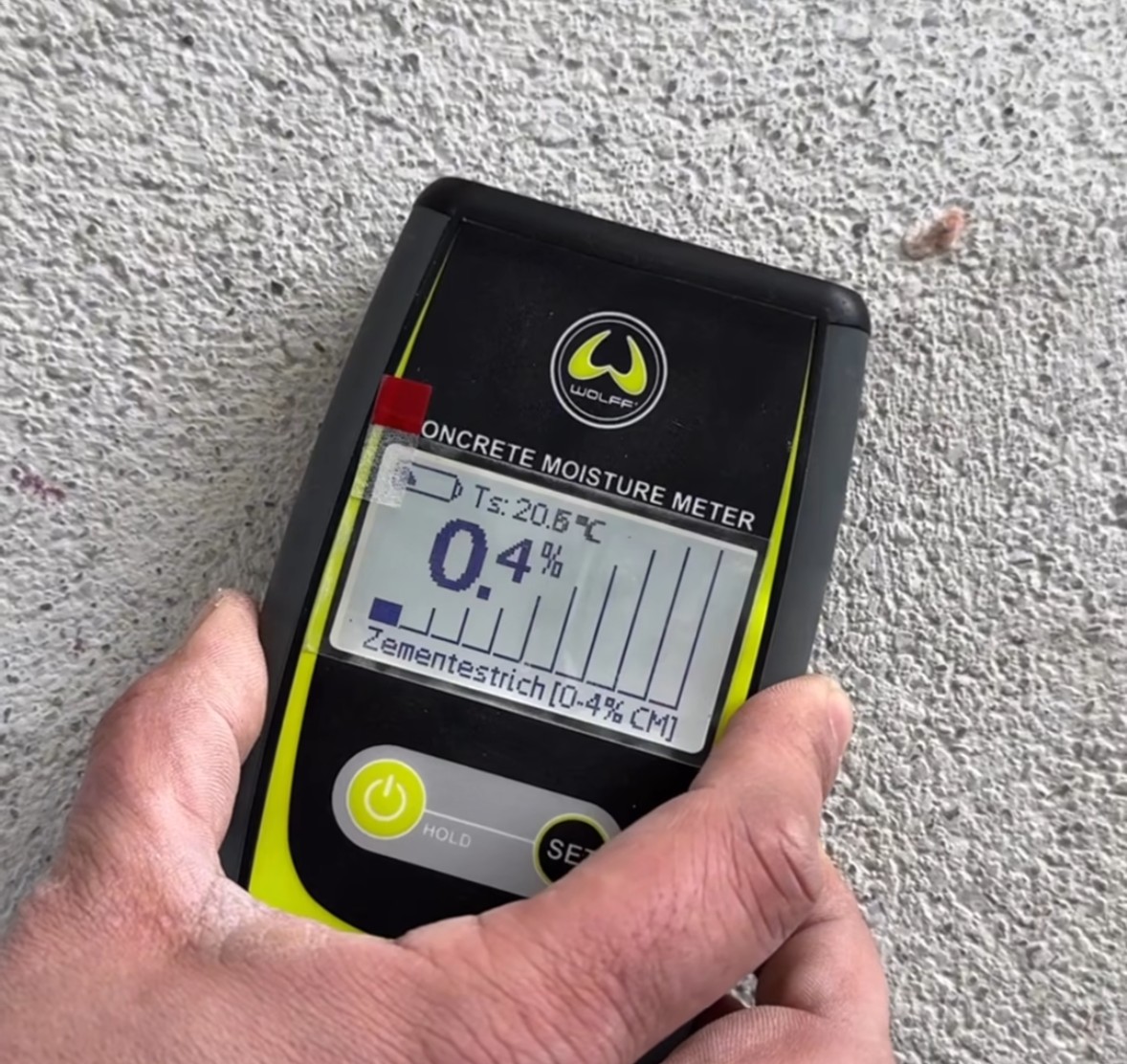
Before installation, we check flatness, strength, cleanliness and residual moisture. Substrate inspection follows a thorough new-build handover inspection before interior work begins. The substrate must meet the tolerance specified by the flooring and adhesive manufacturer or the project standard. A value of 2 mm under a two-metre straightedge is used as a strict project requirement, but it is not a universal limit for every build-up.
Moisture is measured using the method prescribed for the relevant screed. With the carbide CM method, typical indicative maximums are about 2.0 CM% for unheated cement screed and 1.7–1.8 CM% for heated screed. For anhydrite screed, the figures are approximately 0.5 CM%, or 0.2–0.3 CM% for a heated build-up.
For underfloor heating, the prescribed commissioning and heating protocol must be completed and documented. It does not replace the final moisture measurement. The surface must also be sound, dry and free of dust, grease, paint and other separating layers.
Wooden flooring as a complete system
When selecting wooden flooring, we consider more than grain and colour. We check the floor structure, screed type, heating, suitable adhesive, surface finish and future maintenance.
When these layers work together, the result is a floor with a firm feel, calm sound and clean transitions. Minor local damage can be repaired without dismantling the entire room. This is why we use wooden flooring in interiors designed to work well for years—not only on the day they are photographed. We coordinate the material, build-up and details as part of our turnkey interior delivery.


